Welcome to Chroma Cnife
„Culinary. Cutting edge. CHROMA.“
-
If you love to cook, you’ve come to the right place. We produce high-quality kitchen knives for professional chefs in fine dining.
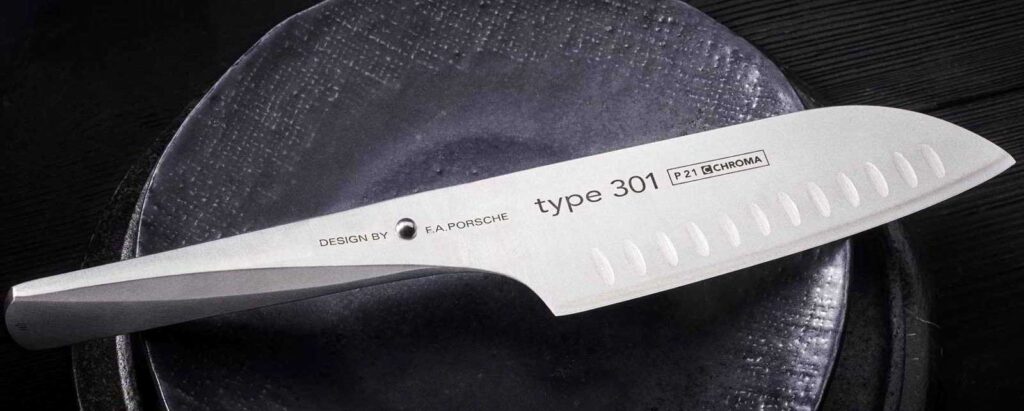
Until a few years ago, we produced a huge range of kitchen knives—from affordable entry-level models to the most expensive one-of-a-kind knife, handcrafted by a Japanese master craftsman for $25,000. We made quite a lot of money, but it wasn’t fun anymore. Putting passion into every single knife became too exhausting, and we could barely keep up. That’s why we radically downsized and now focus exclusively on our best knife: the CHROMA type301, designed by F.A. Porsche.
Culinary. Cutting edge. CHROMA.
It took F.A. Porsche—who had also designed the Porsche 911—four years to perfect the Type 301 kitchen knives exactly as he wanted them. Time and again, he had the prototypes tested by award-winning chefs until they were satisfied. “Butzi” Porsche’s idea was to design a fatigue-free handle for professional chefs—a knife that also looks great.
He said: “The knife series for Chroma follows a precise design approach reduced to the essentials.” Clean lines, balanced proportions, and a consistent choice of materials define tools that prioritize function and handling. The design combines sharpness and ergonomics with a calm, timeless aesthetic.”
Best cnives are spelled with a „C“ – as in CHROMA
In 2001, F.A. Porsche was satisfied with his design, and we were able to begin production. Admittedly, at first our knives weren’t quite as perfect as we had hoped. But we got better every day. Over the years, we changed only one detail—but it was an important one. The handle and the blade are welded together—two different metals. For example, the handle must be able to withstand welding, while the blade needs to be made of particularly hard and brittle steel so that it can be ground down to a thin profile and remain exceptionally sharp for a long time. However, F.A. Porsche didn’t want two separate parts to be visible and insisted that we polish the blade from the tip all the way to the handle so that the knife looks like a single piece. The downside was that this could only be done by hand. Machine polishing, however, is better. The human factor in polishing is critical, because if the craftsman tries to work too quickly, he overheats the blade, which can activate carbon inclusions that may later cause hairline cracks. Steel is a living material! That’s why we’ve been polishing from the back of the knife toward the blade for many years. Since then, there have been no more cracks!
Our goal is to develop the best knife. But that’s probably not possible. 1. The best knife would never get dull. However, every knife eventually gets dull with use. 2. We also can’t make it any sharper because we’d have to grind it down even thinner, but then it would break very easily. It’s already one of the sharpest knives on the market today.
We assign each knife a production code, which you’ll find under the handle. We record every improvement in connection with these production codes. If we’ve made an unintended change, we can immediately identify what we altered based on the code and reverse it. However, over the past ten years, we’ve received perhaps only 2–3 complaints, even though we’ve produced hundreds of thousands of knives. We’re proud of that.
This success is the result of hard work. In our factory, we have two quality control processes: one internal and one external. The internal team continuously monitors every process, while the external team takes samples before each shipment and sends them to its own laboratory. There, hardness, sharpness, edge retention, and resilience are tested. Anything that doesn’t meet our high standards is sent back. Since the workers know this, they work with the utmost care. After all, no one wants to be sent to the department head to explain themselves.
„Culinary. Cutting edge. CHROMA.“
We aren’t the biggest, and we don’t want to be. We strive to be the best. But our knives aren’t for everyone. They need a little love and care, too!
1. Cut only on wooden or plastic cutting boards.
2. Cut only food. Do not cut into bones or frozen foods.
3. Store the knives in a way that protects the blades, such as on a magnetic strip or in a knife block. The blade should not come into contact with any other metal.
4. Especially important: Rinse the knife after each use and dry it thoroughly. The dishwasher is off-limits for high-quality knives.
5. Your new knives are now the sharpest in your kitchen. But even they will gradually become dull with use. It may take a little longer than usual, but it will happen. That’s why it’s important to regularly resharpen the knives with a whetstone. If they’re already dull, it makes more sense to have them sharpened by a professional service.
Best cnives are spelled with a „C“ – as in CHROMA
Would you like to buy a knife from us? Unfortunately, we cannot sell you a knife. We only sell to importers—one importer per country. Please use Google Search to find a retailer near you. If necessary, you can also find the knives on Amazon, but it’s better to buy them from a specialty retailer! If you would like to become one of our importers, please send us an email and provide a detailed introduction about yourself.
Thanks for visiting and happy cooking!
This website is no yet ready – more content to come soon!
Our old original site crashed – you can see all information here.
We are busy manufacturing your cnives and deliver in time. As soon as we have some extra time we will work on this website again! Sorry!
Our typical client – made by AI Our email